
Introduction: Anatomy of a Clean Cut
HSS circular saw blades are often the unsung reason behind every square corner, glassy mitre, and splinter-free rip cut – the feather-thin transition where high-speed teeth tear into raw stock. The motor gives you the torque, but it’s the metallurgy of the blade that determines the result. Whether you’re spinning a 3-horsepower cabinet saw or churning through structural box tubing on a slow-speed cold saw, blade material shapes the outcome of any cutting operation.
The Unsung Hero of Every Clean Cut: How the Right Blade Makes All the Difference
Selecting the wrong tool can cause excessive kerf friction, thermal distortion, and unsightly tooth marks or torn grain fibres. The right blade works in almost complete silence, saving your workpiece and protecting your machine from unnecessary stress.
Carbide vs. HSS Circular Saw Blade: An Overview of the Two Industry Giants
The two main metallurgical options that dominate the tooling market today are high-speed steel (HSS) and tungsten carbide.
High-speed steel revolutionised industrial manufacturing in the early twentieth century by outperforming early carbon tool steels under high friction. Tungsten carbide, which altered the industrial paradigm with powder metallurgy and unprecedented mineral hardness, came later.
Both are still important, but the different chemical compositions result in very different properties regarding edge degradation, tensile deflection, and heat resistance.
- Good for woodworkers and cabinetmakers who want glassy crosscuts and tear-out-free veneer slicing.
- Metal fabricators and machinists involved in cutting speeds, heat dissipation and burr formation on ferrous and non-ferrous stock.
- Dedicated DIYers and Tradespeople wanting to extend tool life and make sound workshop investments.
What To Expect?
A comprehensive overview of tungsten carbide and high-speed steel. Mechanical tolerances, tribological wear resistance, lifecycle expenditure, and material-specific behaviours All these we evaluate and guide you in choosing the precise tooling for your machinery and workflow.
What are HSS (high-speed steel) circular saw blades?
High-Speed Steel (HSS) ┌─────────────────────────────────────────────────────────┐ │ Core Alloy: Fe + W + Mo + Cr + V (+ Co) │ │ Microstructure: Fine, homogenous martensitic matrix │ │ Primary Mechanical Trait: High fracture toughness │ │ Sharpening Method: Standard aluminum oxide / CBN wheels │ └─────────────────────────────────────────────────────────┘
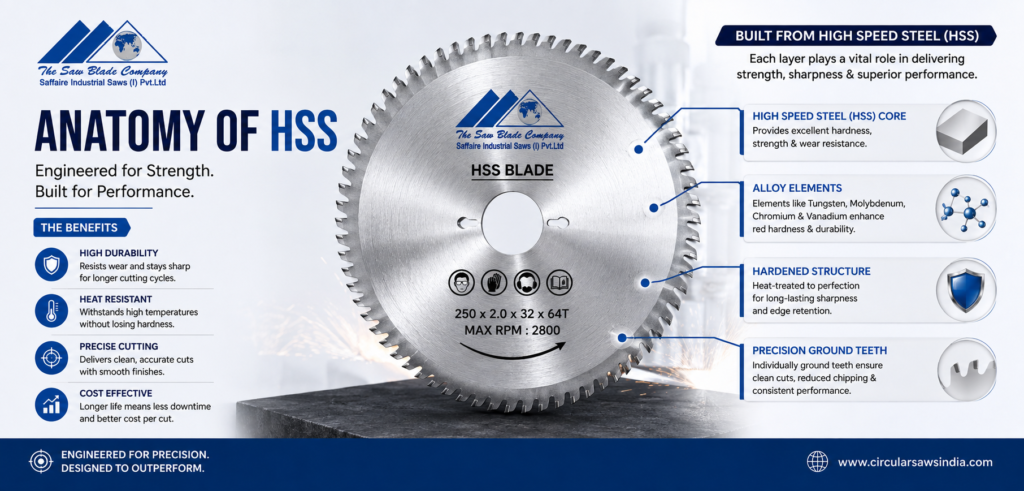
Anatomy of HSS:
Why is this alloy so tough and flexible?
High-speed steel is a complex high-alloy iron formulation containing refractory elements such as tungsten (W), molybdenum (Mo), chromium (Cr), vanadium (V), and sometimes cobalt (Co). These carbide formers precipitate during specific heat treatment and tempering cycles in a tough martensitic matrix.
HSS are not brittle sintered compounds; they have a considerable elastic compliance. Outstanding flexural yield strength means that solid one-piece monolithic blades can absorb shock without cataclysmic fracturing
Best Real World Applications: Where HSS Circular Saw Blades Is the Smartest Tool
- HSS is best for low to medium SFPM jobs where elasticity and vibration damping are more important than high-temperature resistance:
- Dedicated slow speed cold saws cut mild steel tubing, architectural channels and solid bars.
- Slitting saws and metal slotters mounted on standard vertical milling machines.
- Speciality profile moulding knives, hand planes and woodturning gouges where ultra keen cutting edge is valued by woodworkers instead of continuous abrasion resistance.
Unboxing Carbide Tipped Circular Saw Blade
What is Tungsten Carbide and Why is it the King of Modern Cutting
Tungsten carbide (WC) is an inorganic chemical compound made up of equal amounts of tungsten and carbon atoms. Manufacturing process uses powder metallurgy . Microscopic crystals of carbide are embedded into a metallic binder matrix (usually cobalt ($\text{Co}$ ) ) and sintered at high temperature .Instead of stamping the entire blade out of this dense material, manufacturers make Carbide-Tipped (TCT) blades. This is a hybrid design that combines the raw hardness of sintered mineral with the structural compliance of a tempered steel core.
Best Real-World Applications: The High-Volume Winner HSS blade
- In high-production shops, the main workhorse is a carbide circular saw blade:
- Modern architectural millwork, cabinetmaking and panel processing.
- High volume ripping and crosscutting of kiln dried dense hardwoods e.g. Oak, Hard Maple.

One Response